— POSTSCRIPT 1 —
Notes made by Harry Turner
Individual efforts at various forms of rocketry made in the period leading up to WW2 are noteworthy for their unique contribution -- Robert C. Truax working at the US Naval Academy at Annapolis did much sound research on the problems of cooling and in 1938 he built a rocket motor just 35.5cms long with refractory materials lining the nozzle. Several different materials were tested and nearly all the equipment was handbuilt or adapted from whatever he could lay his hands on...
The decade of the 30s had been a time of faltering progress, measured steps forward at an imprecise pace and uncertainty as to where rocket development was going. The often daunting stimulation of prospective flight in space, lit the fires in a score of hearts and minds across Europe and the US, but the sheer magnitude of the problems separating theory from the reality of a manned journey to other worlds was brought home when practical testing began.
...A handful of interested people gathered at the Liverpool home of Philip E. Cleator in October 1933 and plans laid for an inaugural meeting of the British Interplanetary Society on the 13th of the month. At that time Britain had a poor record of support for rocketry and the prospect of space travel. Extensive work had been carried out by groups in Germany and the States during the twenties and thirties. In Britain any practical experiment was hindered by a law going back to 1875, effectively prohibiting rocket tests by members of the general public.
As one of an group of enthusiastic teenagers, captivated by the idea of space travel, who formed the MIS in 1936, I found myself on the wrong side of the law when we organised a meeting to fire several experimental models of rockets built by members. One of the rockets exploded on launch, and we soon found that our audience included several plain clothes detectives from the Explosives department of the Town Hall. Which was the reason why the BIS confined its activities largely to theoretical matters.
One of the souvenirs of my youthful interest is a photograph taken back in July 1938, when I attended a special meeting of the British Interplanetary Society. It was held at the home of R.A. Smith , then HQ of the Society, and the Guest of Honour was Midshipman Robert C. Truax, visiting this country on a US Navy training cruise.
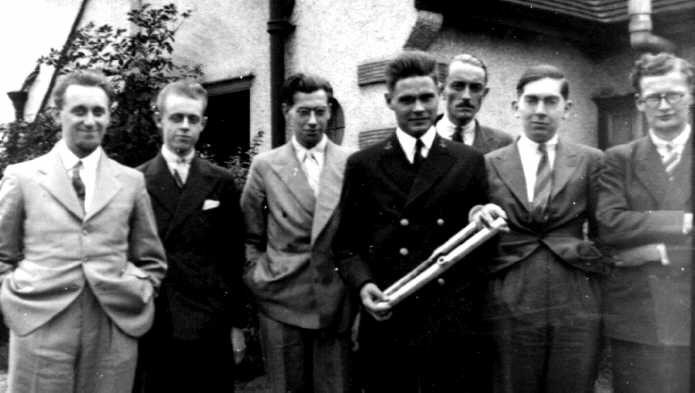
At the Chingford home of R.A.Smith (then HQ of the British Interplanetary Society)
on Sunday 17 July 1938 [L to R:] J.H. Edwards, Eric Burgess, Harry Turner,
Guest of Honour Midshipman Robert C. Truax, USN, holding an experimental
liquid-fuel rocket motor, R.A. Smith, Maurice Hanson & Arthur Clarke.
Bob Truax was in his early twenties, turned up in uniform, and spoke briefly of his appointment to the US Naval Academy at Annapolis in Chesapeake Bay, brought some of the actual thrust chambers that had been under test at the academy.
As I recall, the gist of Bob's talk on that day was about the advantages of training at the Academy, with machine shop facilities conveniently to hand.... to indulge his strictly DIY approach to rocket motor design problems, and experiments with refractory linings.
Further Truax episode notes made by Harry Turner
BIS meeting on 17 July 1938 at R.A. Smith's home in Chingford (92 Larkswood Road, South Chingford, London) then BIS HQ.
Among those present: Midshipman Robert C. Truax (visiting country on a USN training cruise); R.A. Smith; J.H. Edwards; H.E. Ross; L.J. Carter; A.C. Clarke; M.K. Hanson; Eric Burgess and me. Photos taken of groups centred on Bob Truax holding his small experimental liquid fuel rocket motors.
Find cutting about Bob Truax's plans for private shuttle. I also illustrated article on space station by Willy Ley in FANTASY Thrilling Science Fiction |
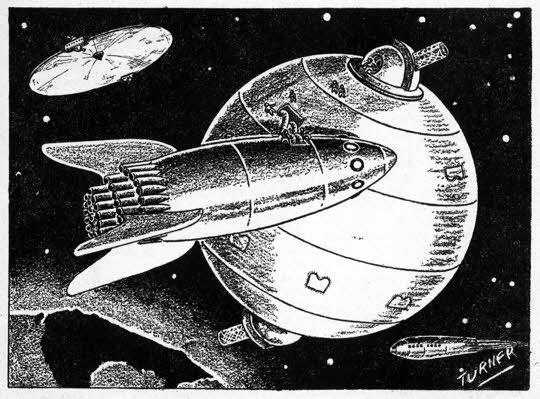 "Terminal In Space" by Willy Ley in FTSF Vol. 1, No. 2 (1939) |
Truax was 21 at time of visit (check). According to Mambo Chicken: main passion has always been rocketry -- pursuing a dream of NASA during past 30 years or so, the fantasy of men in space, orbital stations, a moon base, and Mars missions. The same story that the Russian Tsiolkovsky, the Austrian Herman Oberth, and American Robert Goddard had been telling as far back as the turn of the century.
It began with Sputnik, Gemini and the Moon landings, but then NASA went the way of all government bureaucracies -- including the USSR -- becoming a stultified monster.
Truax was all for private enterprise: he wanted to keep costs down for private astronauts, convinced that after the first successful flight the price could only come down, as with computers. He started early: as a boy in Alameda, Calif, he and a friend fired off test models of their own design (in late 30s) with solid fuels -- most exploded... Buck Rogers fan; read about experiments of Fritz von Opel and Max Valier in Germany -- featured in Popular Mechanics and Sunday supps, and Robert Goddard in Scientific American.
Won an appointment to the US Naval Academy at ANNapolis (Chesapeake Bay) where there was plenty of shop machinery available: he spent time out of classes in the machine shop. Made a variety of thrust chambers and was able to test them out at the naval experimental station across the river Severn -- and he made progress: none exploded.
In 1950 was Lieutenant-Commander). Went on to take flight training at New Orleans Naval Air Base. Left armed forces in 1958.
Graduated from Academy in 1939 and met Prof Robert Goddard (then prof of physics at Clark College, Mass) who had spent past decade on rocket testing in New Mexico desert.
In middle of war Goddard came to Annapolis, where he became director of research on jet propulsion. First job to put rockets, for assisted take-off, on the naval Catalina flying boats, to make them suitable for aircraft carrier duty. Truax headed a separate group put up by the navy, in a hurry for results. and had more down-to-earth ideas.
Goddard used earlier work on petroleum and liquid oxygen; there were inherent problems because of the low temp of loxygen, and ran into difficulties during trials on the Severn river. Truax used a combination of aniline and nitric acid, which ignited spontaneously and the reaction could be turned on and off -- had added advantage that motors could be attached to wing struts and jettisoned once the plane was airborne, and later retrieved.
After the war he was involved in several aspects of the military rocket programme -- working on the Thor rocket for the navy, and on Polaris. Before Sputnik was launched, he was head of an Air Force space prog -- a secret, short term effort to try and beat the Soviets into orbit. When he left the government in the mid-60s, Bob Truax had become one of the world's foremost experts in rocketry.
Eight years later, 8 Sept 1974, Truax was behind the Evel Knievel death-defying jump over the Snake River.